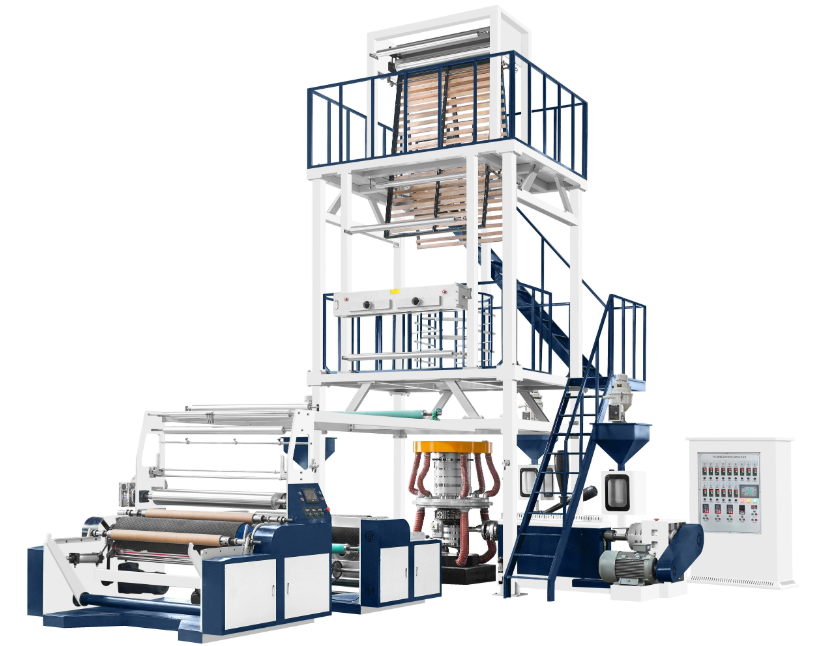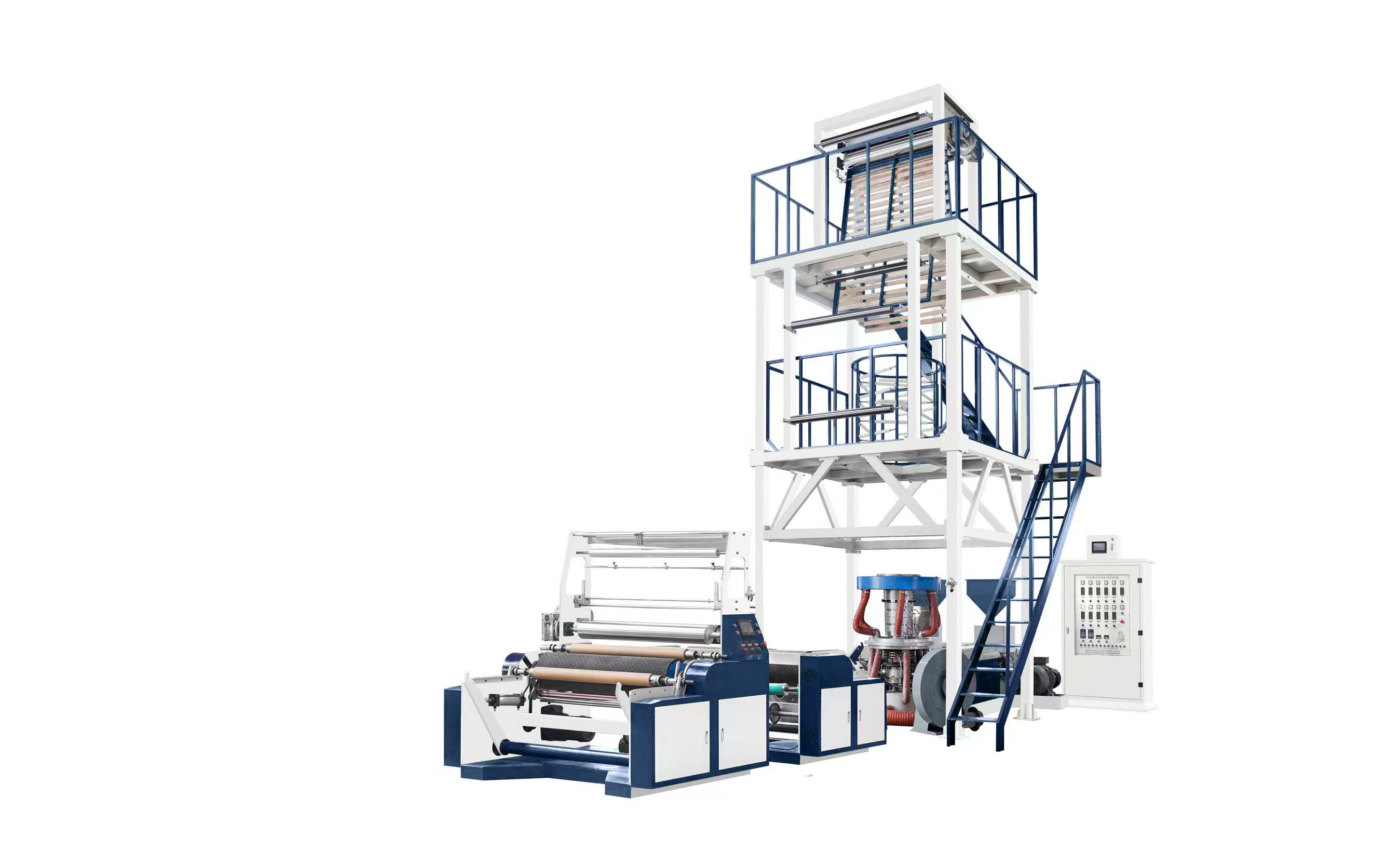
If you are planning to invest in a three-layer line, the real question is not simply which machine looks more advanced. The better question is which structure matches your products, materials, and order mix. Both the three-layer ABA and ABC solutions are multilayer film blowing machine solutions suitable for the production of PE-based and biodegradable films, but they are aimed at different business priorities.
An ABA blown film machine is usually chosen when cost control and recycled-material use are major priorities. An ABC blown film machine is usually more attractive when the buyer needs broader layer-design flexibility, especially for agricultural film, greenhouse film, covering film, or other applications where each layer may need a more independent role. Our ABA machines focus on cost savings and can accommodate up to 50% recycled material, whereas the ABC model is suitable for a wider range of agricultural and greenhouse applications.
What ABA and ABC Blown Film Structures Mean
ABA and ABC are both three-layer co-extrusion structures, but they are not built around the same layer logic. In the ABA structure, the two outer layers are the same “A” material family, while the middle layer is “B”. The A layers are typically used for the outer performance, while the B layer can use recycled material or fillers to reduce material cost.
In the ABC structure, each layer can be treated more independently. Our three-layer ABC machine is suitable for both PE and biodegradable plastics, with applications ranging from greenhouse films, mulching films, and aquaculture films to various other industrial and agricultural films. This makes the ABC configuration particularly well-suited for manufacturers seeking greater flexibility in layer functionality—rather than primarily utilizing the central layer for cost optimization.
The Core Difference in Layer Design
The easiest way to understand the difference is this:
| Structure | Main Logic | Typical Business Priority |
| ABA | Two similar outer layers + one cost-saving or functional center layer | Lower material cost, recycled-material use, mainstream packaging film |
| ABC | Three more independently assigned layers | More flexible layer design, broader technical matching, agricultural or specialty film use |
That is why many packaging buyers see ABA as a practical value-driven structure, while ABC is often seen as the more flexible three-layer option.
Material Use and Cost Efficiency
For many converters, the biggest advantage of ABA is material strategy. It accepts not only recycled materials but can also process PE, reclaimed, and biodegradable materials. This makes it highly attractive to bag manufacturers seeking to maintain an acceptable film appearance while reducing raw material costs through the use of a middle layer.
That does not mean ABC cannot use recycled or biodegradable material. The difference is that ABC is usually chosen less for “cost-saving middle layer” logic and more for broader structure design, especially in film products where different layers may be expected to contribute differently to final performance.
For a packaging business focused on shopping bags, garbage bags, and general flexible packaging, ABA often delivers a strong balance between performance and cost. For a business targeting agricultural films or more specialized film structures, ABC may justify the higher complexity.
Film Performance Comparison: Strength, Flexibility, and Application Fit
When comparing ABC and ABA structures, the real difference is not simply the number of layers, but how those layers are used to balance strength, flexibility, and end-use performance.
An ABA blown film machine is often preferred for packaging applications where cost efficiency and practical mechanical performance matter most. Because the two outer layers can maintain the film’s surface quality while the center layer is optimized for material cost, ABA structures are widely used for shopping bags, garbage bags, general packaging film, and other high-volume products. In many cases, this structure provides a good balance of toughness, sealability, and production economy.
An ABC blown film machine, on the other hand, is more suitable when each layer is expected to play a more independent role in the final film structure. This gives the producer greater flexibility in adjusting performance characteristics such as stiffness, barrier behavior, surface properties, or material distribution. For that reason, ABC structures are often better suited to more specialized applications such as agricultural film, greenhouse film, covering film, and other products where performance requirements go beyond standard packaging needs.
In simple terms, ABA is often the stronger choice for mainstream bag and packaging production, while ABC is usually more attractive for film products that require broader structure flexibility and more application-specific performance design.
Which Applications Fit ABA Better

An ABA blown film machine is usually the better choice when your factory mainly produces:
This is exactly where the ABA structure makes commercial sense. If your order mix is high-volume, price-sensitive, and focused on mainstream film products, ABA can be easier to justify because it supports lower raw-material cost without moving immediately to a more complex machine structure.
Which Applications Fit ABC Better

An ABC blown film machine is usually the stronger option when your product line includes:
greenhouse film
agricultural covering film
aquaculture film
biodegradable film projects with more specific layer demands
film products where customers expect broader three-layer design flexibility
This makes ABC a more suitable option for manufacturers producing greenhouse film, agricultural covering film, aquaculture film, and biodegradable films with more specific functional requirements. It is also a stronger choice when customers expect a wider range of film properties or when the business is moving toward more specialized and higher-value film applications.
Investment, Operation, and Maintenance Considerations
From an investment perspective, ABA is often the more practical choice for manufacturers who want to move from single-layer or two-layer production into three-layer film without adding too much system complexity. Its structure is generally easier to manage in daily operation, and for many standard packaging applications, it can deliver a good balance of output, cost control, and production stability.
ABC usually requires a more complex production setup, but that added complexity also brings greater flexibility in layer design and material distribution. For businesses producing more specialized films or planning to expand into higher-value applications, that flexibility may justify the higher investment and more demanding operation.
In terms of maintenance, the decision is not about one machine being “basic” and the other being “advanced.” It is more about production goals. If the main priority is efficient, stable manufacturing of mainstream packaging film, ABA often offers a more economical operating model. If the priority is broader product capability and more technical control over film structure, ABC can be the better long-term choice despite the higher complexity.
A Practical Comparison for Packaging Buyers
| If Your Priority Is... | Better Fit in Many Cases | Reason |
| Lower material cost | ABA | Easier to use recycled content in the middle layer |
| Mainstream bag-film production | ABA | Strong fit for common flexible packaging and bag applications |
| Greenhouse and agricultural films | ABC | Better aligned with your current ABC machine positioning |
| More flexible three-layer design | ABC | Three independent layers offer broader structure options |
| Simpler operating logic | ABA | Lower system complexity |
| Broader technical expansion | ABC | Better for more differentiated film products |
This is why the “better” machine depends on the business model, not just on the structure name.
Common Mistakes Buyers Should Avoid
One common mistake is assuming ABC is automatically superior because it sounds more advanced. In reality, if your orders are mostly standard packaging film and you care most about cost control, ABA may be the smarter investment. Another common mistake is buying ABA mainly for low price without checking whether future product plans may require more layer flexibility than the structure can easily support.
A third mistake is focusing only on output capacity or film width while ignoring the actual product direction. A machine may look attractive on paper because it offers higher output or a wider production range, but that does not automatically make it the right choice. The more important issue is whether the machine structure matches the type of film the business plans to produce. In many cases, application fit is far more important than headline specifications alone.
How to Choose the Right Machine for Your Packaging Business
If your business mainly serves price-sensitive packaging markets and wants to lower raw-material cost while maintaining usable outer-layer quality, ABA is often the better starting point. If your business is expanding into agricultural film, greenhouse film, biodegradable specialty structures, or other products where each layer may need a more independent role, ABC is often the stronger option.
A simple decision rule is this:
Conclusion
For most packaging buyers, the choice between ABA and ABC is not about which machine is universally better. It is about which machine better supports your product plan, material strategy, and market positioning. An ABA line is often the better business decision for mainstream bag and packaging film production because it offers practical cost savings and flexible material use. An ABC line is often the better technical decision for more differentiated three-layer films, especially in agricultural and greenhouse-related applications.
If you start from your actual products, not just the machine name, the right answer becomes much clearer.
As a professional manufacturer of plastic and packaging machinery, Wenzhou Xingpai Machinery Co., Ltd. provides a wide range of equipment including film blowing machines, plastic bag making machines, flexographic printing machines, slitting machines, plastic recycling machines, and nonwoven bag making machines. Founded in 2002, the company focuses on customized solutions, one-stop production line support, and long-service-life machine configurations for customers in different markets. If you are choosing between an ABA or ABC blown film machine, you are welcome to contact our team to discuss your materials, target products, and production requirements.
FAQs
1. Can an ABA blown film machine help reduce material cost?
Yes. In many cases, an ABA blown film machine is chosen because the middle layer can use more cost-effective material combinations, which helps reduce overall raw material cost while keeping the outer layers more suitable for product appearance and performance.
2. Is an ABC blown film machine always better than an ABA machine?
Not necessarily. An ABC blown film machine offers more flexibility in layer structure, but that does not automatically make it the better choice for every factory. If your main products are standard packaging bags and cost control is a key target, an ABA structure may be the more practical option.
3. Which machine is more suitable for biodegradable film production?
Both structures can be used for biodegradable film production, but the better choice depends on the final film application, material formulation, and the level of layer control required. Buyers should evaluate the target product rather than choose only by machine name.
4. How should a new packaging factory choose between ABA and ABC?
A new factory should first look at its target products, expected customer orders, raw material strategy, and budget. If the business will focus on common bag and packaging film, ABA may be a more efficient starting point. If the goal is to enter more specialized film markets, ABC may offer better long-term flexibility.
5. What should buyers ask suppliers before ordering a multilayer film blowing machine?
Buyers should ask about suitable materials, target film width and thickness range, output expectations, layer structure options, optional configurations, and which products the machine is best matched for. For a multilayer film blowing machine, matching the equipment to the product plan is more important than comparing structure names alone.